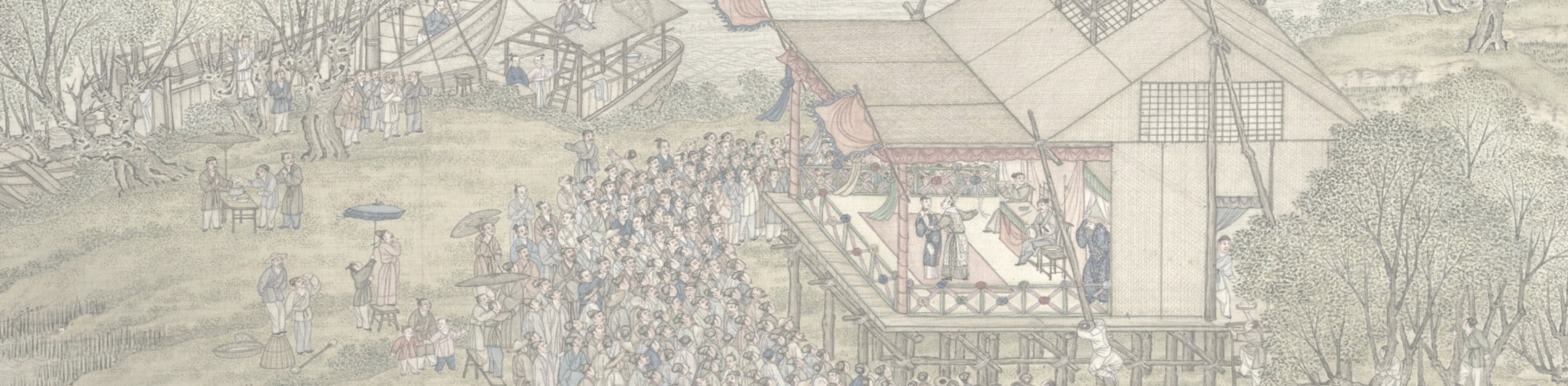
Why the Stage Became a Cultural Crossroads
Chinese classical stage arts are often discussed through individual traditions—opera forms, regional styles, or named schools. These distinctions are useful, but they do not explain why so many different practices repeatedly came to rest on the same stage.
This convergence was not a historical accident. It arose from the conditions the stage alone could provide.
Any theatrical performance must present human life in a form that can be seen and followed. Language carries memory and value. Movement reveals intention and control. Costume situates the body within shared norms. Music shapes time and continuity. Story gives action consequence. For this reason, theater everywhere draws together multiple strands of culture. It cannot do otherwise.
What distinguishes the Chinese context is not that these elements converged, but that the stage became one of the few places where they could remain together over long stretches of time.
For much of Chinese history, many forms of cultural knowledge could not be preserved through texts or objects alone. Words could record stories, but not timing. Images could suggest posture, but not weight or restraint. What mattered most—how an action was carried, how intention survived pressure, how conduct appeared when observed by others—required presence. It required repetition. It required a space where behavior could unfold again and again before living eyes.
The stage provided this continuity. It offered a stable setting in which language, movement, music, costume, and narrative could continue to appear together, not as fragments stored in separate places, but as a living whole. Each performance renewed the alignment. Each appearance tested whether these elements could still hold together under use. What endured was not what could be recorded most easily, but what could remain intelligible when enacted.
Over time, the stage ceased to function as mere display. It became a form of cultural support. Traditions survived there not because they were fixed in doctrine or preserved intact, but because they remained in motion—used, adjusted, and recognized in performance. The stage did not store culture; it sustained it, allowing practices to remain visible, shareable, and responsive to human presence across generations.
The stage did not store culture; it sustained it.
This is why so many traditions came to reside on the stage. Not because theater defined their meaning, but because it provided the conditions under which they could remain active, intelligible, and shared.